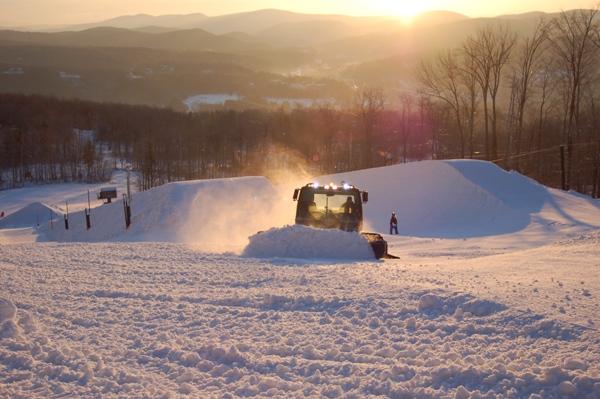
Friday, March 21, 2008
Sunny Skiing in California
Monday, March 10, 2008
A few links
We just got back from Stowe, to celebrate our first anniversary, and oddly enough this link makes it sound like we're not the only ones who thought it was a good place for couples.
And lastly, we are looking at visiting Northstar in Tahoe, which has this recent writeup in the Miami Herald of all places. I would not have thought folks would have trekked that far to visit it. You can see where it is located to the left.
Tuesday, March 04, 2008
A great few days at Stowe
Tuesday, February 26, 2008
Pretty good skiing during President's week
We got a few days of skiing in on the weekends bookending the President's holiday week at Okemo. The first weekend we took the godkids out and zoomed around the mountain. Lines were long at some places but we were able to get some good runs in on the Jackson Gore part of Okemo.The next weekend was better, since there had been abundant snowfall during the weekend, and the temperature had stayed cold, keeping the surface conditions soft and powdery. This time I enjoyed the South Face side of the mountain ridge, where few people were at. Having my skis tuned up helped a lot, especially on the icier spots.
The next weekend we are going up to Stowe, where I have not been in perhaps a decade. I am looking forward to seeing the extensive improvements AIG has made there.
Tuesday, February 05, 2008
Too Wet on Feb 2 & 3
After seeing the snow and wind conditions the next day, we ended up staying in and not heading out to the mountain. There were plenty of chores around the house to keep us busy and we both caught up on some reading.
Hopefully things will be better by the President's Holiday.
Monday, January 21, 2008
Fast Skiing at Okemo, Jan 20
It has been a long time since I've updated the blog, but we had a nice day of skiing yesterday at Okemo. The weather was clear and sunny, but cold as it can be without a cloud blanket. I needed my footwarmers to handle the mid teen temps. We have not had much fresh snow in the last week, and the groomers had preened the trails into flat, crispy fast movers. We took the kids over to the South Face and skiied all the trails off the Sunrise lift. They were fast, and I could feel the dullness of my midseason edges on my Atomic's .After a few hours my hands were just too cold, and it was time to pack it in. I would have expected more folks at the mountain, but it wasn't that crowded.
Saturday, July 14, 2007
Gstaad Trip Report
I know it has been much delayed, but here's a report from our honeymoon to Gstaad. You can see pictures from the trip on the button to the right, under links.
We started off by flying on Alitalia from New York to Milan, and then connecting to a flight to Geneva and then taking a train from the airport to the village of Gstaad. Although we were traveling business class (which was a treat that Jennifer had been saving her miles for years for) it took quite a while to get there. Alitalia, by the way, is a government owned airline, and things feel sort of faded and dated on it. We left on Sunday right after our wedding, and arrived Monday evening. I suppose things could have been faster if we'd chosen a prepacked tour, since they would have lined up direct flights and bus transfers. Gstaad as a ski destination tends not to be on the list of ready made packages because it has the unfortunate combination of beeing too costly and is not snow sure.
After almost 20 hours of travel, we arrived at the Berherhof in Gstaad. The hotel was perfectly situated, right by the train station and buses to the mountains, and in the middle of the beautiful pedestrian/car free village. In addition the hotel was of a very high standard in accomodations -- in particular the wood work and bathroom fixtures. The kitchen was closed on our arrival, so we went down the street and got a burger at a local cafe. We could sit on our balcony and look over the village, and up at the famous Gstaad Palace hotel sited above the town.
On our first full day in the village, we slept in late and then went exploring, foraging for lunch. We made our way through the village, marvelling at the curious bronze sculptures scattered about.
There was an iron cow by the watering hole, elves under the bridge, and more. Someone here has a touch of whimsy. We had savory crepes at a cafe after getting the lay of the land and figuring out where the ski bus shuttles were. The core pedestrian village is filled with expensive boutiques and luxury product stores, but they were interesting to window shop. One store was particularly fascinating -- Kitchen & Table is its name in English. We wandered around the 3 floors of this for almost an hour. The picture to the right is from their pottery department. We came back a few days later, and after a lot of deliberation, selected a fondue pot and burner as a useful memento of the visit. Afterwards we came back to the hotel and relaxed on the balcony for a while while we mulled over dinner options. One of the tour books I had acquired, Lonely Planet, suggested the Post Hotel Rossli as a good choice for classic Swiss fare, so we made our way there later that night. It was a good suggestion indeed, and I enjoyed my rosti and Swiss white wine.
The next morning we were pretty refreshed after the previous days relaxing and exploring, so we were ready to go skiing. We had breakfast downstairs and grabbed a bus from outside the hotel to one of our local village's ski areas -- Eggli. Gstaad is actually a "super ski region" of almost a half dozen villages connected by bus/train/ski trails going up and down the Saanenland valley. Gstaad is the most charming village and has the most local ski areas (3) but they are somewhat less natural fall line skiing than the other villages. I guess the American comparable would be Aspen and its local ski areas, although in the Gstaad Super Ski region, some of the areas are skiiable from each other. Once we got to the Eggli area we took a gondola to the peak and started to make our way down to the Chalberoni mid valley station. Some of the trails down this way were in poor condition due to lack snow, and too much sun on these south facing pistes. Once we got down to the Chalberoni lodge, Jenn stopped to rest and get some lunch, while I made my way up to the top of the the next ridge over and skiied that. There was hardly anyone up there and the conditions were much better, although as I got down to lower altitudes the soft snow became tiring to ski through. We schlepped back to Eggli and then took the gondola back down the village.
On Wednesday we planned a dinner at the haute cuisine restaurant, Chlosterli, which was a few miles out of town. While that was being set up by the concierge we set out to find electronic connectors that would let us hook our iPod up to the hotel room's stereo. Fortunately we found a Swiss equivalent of RadioShack down a side alley and we got everything sorted out swiftly. From there we took a little side tour of that edge of village. There was a fantastic amount of construction going on; we heard that most of the new chalets are being custom built for Russian oligarchs. Price tags seemed to be in the $5-8mm range, high even for a top end ski resort. When we came back I went down to the gym and tried the hot and cold saunas, followed by a few laps in the pool. After all this we were feeling refreshed and took a taxi to the Chlosterli. We had signed up for the full 9 course dinner which took three plus hours. The range of preparations and the creativity of the chef were extraordinary; it really was one of the greatest meals I have ever had. Everything was supremely fresh and flavorful, with just the right balance between traditional spices and creative ones. We had a delicious bottle of Leroy red burgundy to go with it, which made me want to try cellaring a few on my own, until I saw how costly they are in the US.
On Thursday, Jennifer had a spa session set up for a hot rocks massage therapy while I went down to the gym/sauna in our building after breakfast. After a lazy day relaxing like this we then went to a guitar recital given in the local Roman Catholic church/kirch. Oddly enough, it was a Swiss man singing traditional American devotionals on a guitar; it was weird hearing Sweet Chariot with a thick German accent. The performance was heartfelt, but technically/muscially light years behind our own Holy Trinity. After that we went out for Italian food for dinner. The restaurant was called "Rialto" and was superb. We both had homemade tagliatele with a veal ragu sauce. It had carrots in it and the feel of having been simmered in wine and milk for hours like a good bolognese sauce should be. It was hard to have a bad meal in Gstaad since the standard of both hotels/dining is so high. We walked back to the hotel feeling a slight chill in the air. By midnight, a light snow would be coming down pretty consistently.
On Friday we got up early as it was looking like a powder day from the view from our balcony. We had a hurried breakfast and hopped on the "GoldenCar" , a special bubble shaped rail compartment, from Gstaad to the upvalley village of Schonried. The story we had heard at breakfast was that this area tended to get better snow, and its terrain was wide and forgiving, perfect for the two of us to enjoy skiing together. After a 20 minute scenic train ride, we hopped off at the Schonried baanhof and manhandled our gear toward the lifts. Unlike at typical American resorts, which have some kind of base area for changing and assorted sundries, the base stations in the Gstaad super ski area, tended not to have much beyond a lift area and a ticket booth. Most folks would rent equipment, if needed, in town and then get food up on the mid/top mountain restaurants and warming huts. The gist of all of this is that there was not any ski lockers at the mountain area, or at least any that we could locate, but we had a small inkling that may happen so I'd brought our gear in a daypack style bag. We just skiied with all of our stuff on ourselves, which would make it easy to leave from a different village.
When we got up to the top of the mountain, the snow was coming down thickly and the powder was mid calf. We happily skied down a few runs of this and then tacked down into a broad valley that spanned the way to another vilage. Here the runs were well sheltered from the blowing snow, and as the wind let up, we could lap the trio of runs here. The vertical on the upper runs was probably only 1500 ft or so, but this area seemed popular for families skiing with mixed abilities, so we saw lots of kids here. After a while Jenn went to the Hornberg mittelstation while I kept on doing fast cruises on this lift. It felt good to put force on my Achilles again after so many months of babying it. We were both getting hungry now, so I collected Jenn from the Hornberg area and we zipped down to a midmountain lodge hidden in a little side nook. We got some warm drinks and sandwiches at this place, called Lochstoffel. After that we skiied down to the next town over, called Saanenmoser. The bottom had gotten a little slushy and it was getting time to call it a day, so Jenn decided to have a gluwhein while she waited for me. I thought it might be end of this years ski season for me (I was wrong about that) so I decided to keep doing a few runs on this gondola serviced run. It was pretty nice and broad but slushy near the bottom. Still it was a great way to end the day, and since we had all our stuff with us, we could just stroll down to Saanenmoser's baanhof and catch the train home, exhausted and happy. We got to the station about 10 min before the next train home, so we didn't have to wait. It was a great day.
On Saturday last day of relaxing. Olden. Hiking above town.
Sunday. Train back to Geneva. Dinner with Alain
Monday. Fly back to the USA.
Tuesday. R&R get pets.
We started off by flying on Alitalia from New York to Milan, and then connecting to a flight to Geneva and then taking a train from the airport to the village of Gstaad. Although we were traveling business class (which was a treat that Jennifer had been saving her miles for years for) it took quite a while to get there. Alitalia, by the way, is a government owned airline, and things feel sort of faded and dated on it. We left on Sunday right after our wedding, and arrived Monday evening. I suppose things could have been faster if we'd chosen a prepacked tour, since they would have lined up direct flights and bus transfers. Gstaad as a ski destination tends not to be on the list of ready made packages because it has the unfortunate combination of beeing too costly and is not snow sure.
After almost 20 hours of travel, we arrived at the Berherhof in Gstaad. The hotel was perfectly situated, right by the train station and buses to the mountains, and in the middle of the beautiful pedestrian/car free village. In addition the hotel was of a very high standard in accomodations -- in particular the wood work and bathroom fixtures. The kitchen was closed on our arrival, so we went down the street and got a burger at a local cafe. We could sit on our balcony and look over the village, and up at the famous Gstaad Palace hotel sited above the town.
On our first full day in the village, we slept in late and then went exploring, foraging for lunch. We made our way through the village, marvelling at the curious bronze sculptures scattered about.
There was an iron cow by the watering hole, elves under the bridge, and more. Someone here has a touch of whimsy. We had savory crepes at a cafe after getting the lay of the land and figuring out where the ski bus shuttles were. The core pedestrian village is filled with expensive boutiques and luxury product stores, but they were interesting to window shop. One store was particularly fascinating -- Kitchen & Table is its name in English. We wandered around the 3 floors of this for almost an hour. The picture to the right is from their pottery department. We came back a few days later, and after a lot of deliberation, selected a fondue pot and burner as a useful memento of the visit. Afterwards we came back to the hotel and relaxed on the balcony for a while while we mulled over dinner options. One of the tour books I had acquired, Lonely Planet, suggested the Post Hotel Rossli as a good choice for classic Swiss fare, so we made our way there later that night. It was a good suggestion indeed, and I enjoyed my rosti and Swiss white wine.
The next morning we were pretty refreshed after the previous days relaxing and exploring, so we were ready to go skiing. We had breakfast downstairs and grabbed a bus from outside the hotel to one of our local village's ski areas -- Eggli. Gstaad is actually a "super ski region" of almost a half dozen villages connected by bus/train/ski trails going up and down the Saanenland valley. Gstaad is the most charming village and has the most local ski areas (3) but they are somewhat less natural fall line skiing than the other villages. I guess the American comparable would be Aspen and its local ski areas, although in the Gstaad Super Ski region, some of the areas are skiiable from each other. Once we got to the Eggli area we took a gondola to the peak and started to make our way down to the Chalberoni mid valley station. Some of the trails down this way were in poor condition due to lack snow, and too much sun on these south facing pistes. Once we got down to the Chalberoni lodge, Jenn stopped to rest and get some lunch, while I made my way up to the top of the the next ridge over and skiied that. There was hardly anyone up there and the conditions were much better, although as I got down to lower altitudes the soft snow became tiring to ski through. We schlepped back to Eggli and then took the gondola back down the village.
On Wednesday we planned a dinner at the haute cuisine restaurant, Chlosterli, which was a few miles out of town. While that was being set up by the concierge we set out to find electronic connectors that would let us hook our iPod up to the hotel room's stereo. Fortunately we found a Swiss equivalent of RadioShack down a side alley and we got everything sorted out swiftly. From there we took a little side tour of that edge of village. There was a fantastic amount of construction going on; we heard that most of the new chalets are being custom built for Russian oligarchs. Price tags seemed to be in the $5-8mm range, high even for a top end ski resort. When we came back I went down to the gym and tried the hot and cold saunas, followed by a few laps in the pool. After all this we were feeling refreshed and took a taxi to the Chlosterli. We had signed up for the full 9 course dinner which took three plus hours. The range of preparations and the creativity of the chef were extraordinary; it really was one of the greatest meals I have ever had. Everything was supremely fresh and flavorful, with just the right balance between traditional spices and creative ones. We had a delicious bottle of Leroy red burgundy to go with it, which made me want to try cellaring a few on my own, until I saw how costly they are in the US.On Thursday, Jennifer had a spa session set up for a hot rocks massage therapy while I went down to the gym/sauna in our building after breakfast. After a lazy day relaxing like this we then went to a guitar recital given in the local Roman Catholic church/kirch. Oddly enough, it was a Swiss man singing traditional American devotionals on a guitar; it was weird hearing Sweet Chariot with a thick German accent. The performance was heartfelt, but technically/muscially light years behind our own Holy Trinity. After that we went out for Italian food for dinner. The restaurant was called "Rialto" and was superb. We both had homemade tagliatele with a veal ragu sauce. It had carrots in it and the feel of having been simmered in wine and milk for hours like a good bolognese sauce should be. It was hard to have a bad meal in Gstaad since the standard of both hotels/dining is so high. We walked back to the hotel feeling a slight chill in the air. By midnight, a light snow would be coming down pretty consistently.
On Friday we got up early as it was looking like a powder day from the view from our balcony. We had a hurried breakfast and hopped on the "GoldenCar" , a special bubble shaped rail compartment, from Gstaad to the upvalley village of Schonried. The story we had heard at breakfast was that this area tended to get better snow, and its terrain was wide and forgiving, perfect for the two of us to enjoy skiing together. After a 20 minute scenic train ride, we hopped off at the Schonried baanhof and manhandled our gear toward the lifts. Unlike at typical American resorts, which have some kind of base area for changing and assorted sundries, the base stations in the Gstaad super ski area, tended not to have much beyond a lift area and a ticket booth. Most folks would rent equipment, if needed, in town and then get food up on the mid/top mountain restaurants and warming huts. The gist of all of this is that there was not any ski lockers at the mountain area, or at least any that we could locate, but we had a small inkling that may happen so I'd brought our gear in a daypack style bag. We just skiied with all of our stuff on ourselves, which would make it easy to leave from a different village.
When we got up to the top of the mountain, the snow was coming down thickly and the powder was mid calf. We happily skied down a few runs of this and then tacked down into a broad valley that spanned the way to another vilage. Here the runs were well sheltered from the blowing snow, and as the wind let up, we could lap the trio of runs here. The vertical on the upper runs was probably only 1500 ft or so, but this area seemed popular for families skiing with mixed abilities, so we saw lots of kids here. After a while Jenn went to the Hornberg mittelstation while I kept on doing fast cruises on this lift. It felt good to put force on my Achilles again after so many months of babying it. We were both getting hungry now, so I collected Jenn from the Hornberg area and we zipped down to a midmountain lodge hidden in a little side nook. We got some warm drinks and sandwiches at this place, called Lochstoffel. After that we skiied down to the next town over, called Saanenmoser. The bottom had gotten a little slushy and it was getting time to call it a day, so Jenn decided to have a gluwhein while she waited for me. I thought it might be end of this years ski season for me (I was wrong about that) so I decided to keep doing a few runs on this gondola serviced run. It was pretty nice and broad but slushy near the bottom. Still it was a great way to end the day, and since we had all our stuff with us, we could just stroll down to Saanenmoser's baanhof and catch the train home, exhausted and happy. We got to the station about 10 min before the next train home, so we didn't have to wait. It was a great day.On Saturday last day of relaxing. Olden. Hiking above town.
Sunday. Train back to Geneva. Dinner with Alain
Monday. Fly back to the USA.
Tuesday. R&R get pets.
Thursday, April 05, 2007
We're back
I've had some difficulty posting in the last 6 weeks, plus have been very busy of course. I'm going to get back to the bi weekly post here, with a trip report on Gstaad.
J. and I watched this recently -- it was pretty good. I can pretty much watch these endlessly.
Monday, February 12, 2007
Saturday, February 10, 2007
Thursday, February 08, 2007
A Flickr picture of Gstaad
Someone posted this picture on Flickr a few days ago from their visit to Gstaad. Looks suspiciously snowy. Here's A puff piece on Gstaad from a newspaper in Massachusetts, which must have been a travel agent perk or something. And here's a local paper's take on the conditions from last week, in English which has the feel of being written by an ex patriate Anglo or American. Also here's a cool interactive map with on hill cameras, click through to the flash player to see what the various regions around Gstaad are up to. I wish there was more snow there, but its beyond our control.
Wednesday, February 07, 2007
An interesting article on Aspen
Our Aspen pictures are still on Yahoo, and you can still order a picture book of them from the menu. It's pricey ($69 or so) but I got one anyways.
Added bonus - two other bloggers recently talking about Okemo . And a teenager on a traditional club bus trip to Okemo. It's actually kind of insightful into todays youth. I wonder if alpine race camp is like this.
Monday, February 05, 2007
Finally, lots of snow in Vermont
We just got back from Vermont, which was blessed with plenty of snow. We got at least 4" on Friday night (I was lucky to get up the road to the cabin) and another couple inches on Saturday night. Although this picture was not taken by us, this is what the village looked like.On Saturday we went to Ludlow's Okemo mountain and Jenn skiied around the base area, while I read Harold Harb's book on Ski Flexing and Fitness. It was pretty good; I remember when I ordered this that it had been on back order for quite some time which was annoying. Amazon's value proposition drops when one has to wait for weeks or months to get something. It seemed to me that the mountain wasn't that crowded, at least from the parking lot and base area, but the others said there were some lines at the Northstar lift. Conditions were probably the best they have been all year -- fresh snow, clear skies, and although cold, not viciously so.
Tuesday, January 30, 2007
Switzerland hotels
I finally sorted out all the hotels for our trip to Switzerland. It appears that hotels there have not gotten online for direct booking as much as US properties have.
We're staying at the Bernerhof while in Gstaad and we'll overnight in Geneva at the Hotel Suisse . Both seem to be well regarded by the Michelin guide as well as TripAdvisor.com which has user reviews.
Suisse Hotel


Bernerhof
Added bonus - here's a picture from this morning at Okemo, Vermont. It looks like the junction of trails where Sapphire gets steeper. It could also be Sunburst; they have a similar feel in the top part.
We'll be up there again this weekend; the snow will probably be the best of the season.
Here's a post about snowmaking previously: White Lies
We're staying at the Bernerhof while in Gstaad and we'll overnight in Geneva at the Hotel Suisse . Both seem to be well regarded by the Michelin guide as well as TripAdvisor.com which has user reviews.
Suisse Hotel
Bernerhof
Added bonus - here's a picture from this morning at Okemo, Vermont. It looks like the junction of trails where Sapphire gets steeper. It could also be Sunburst; they have a similar feel in the top part.
We'll be up there again this weekend; the snow will probably be the best of the season.Here's a post about snowmaking previously: White Lies
Thursday, January 25, 2007
Good news for New England skiiers
Clearly most of you can feel the chill in the air, and perhaps see a few flakes in the sky, but it looks like Winter is back for a little bit. Vermont should have high quality skiing for the next 2-3 weeks basked on pockets of Arctic air that are swirling our way, and hitting moisture pockets, creating snow. Good times coming!
The link below is a technical discussion on the weather metric NAO which is a good indicator for what will happen in our region. The NAO is currently negative, which is good for both the Alps and New England skiing. Here is a technical definition of the NAO
Also below, is a pretty unreal descent by a snowboarder. Just watching this is scary.
The link below is a technical discussion on the weather metric NAO which is a good indicator for what will happen in our region. The NAO is currently negative, which is good for both the Alps and New England skiing. Here is a technical definition of the NAO
Also below, is a pretty unreal descent by a snowboarder. Just watching this is scary.
Tuesday, January 23, 2007
Cold in the East = Snow at Okemo

Clearly the bitter cold here in the East is translating into some fresh, good snow in Vermont, which is much needed. It appeared to me that the snow Jennifer
was skiing on at was better than one would have expected, although not as good as Quebec's.
It takes a lot of snow to make snowboarding pipes and parks, so this early morning picture from Okemo on Jan 23 is a good sign that they actually have enough to get a large part of their mountain open.
Monday, January 22, 2007
Tuesday, January 16, 2007
Great trip!
Despite the travel delays in getting home, it was a very nice trip.
Thanks everyone and I look forward to seeing you in a few weeks.
I'll clean up the Yahoo pictures site over the next few days - there are a lot of dupe photos as well as blurry/unusable ones - and get some captions on them.
Arv
Thanks everyone and I look forward to seeing you in a few weeks.
I'll clean up the Yahoo pictures site over the next few days - there are a lot of dupe photos as well as blurry/unusable ones - and get some captions on them.
Arv
Tuesday, January 09, 2007
Directions & Tremblant destination
Sean discovered this map of where we are staying, which is called the Village Pietonnier, which loosely translated into American is "Shrine to Celine Dion". We are at the Somnet des Niege complex.Here are some directions for driving
From Montréal and International Airports
Take autoroute 15 North to Sainte-Agathe. After Sainte-Agathe, the 15 Northmerges with 117. Continue on the 117 North past Saint-Jovite. Take exit 119(Montée Ryan) to Chemin Duplessis and follow indications for TremblantResort. 1 1/2 hour.
From Boston
Take autoroute 93 North, then 89 North to U.S./Canada border. Follow route133 North to 10 West towards Montréal. Follow signs to route 15 North. Takeautoroute 15 North to Sainte-Agathe. After Sainte-Agathe, the 15 Northmerges with 117. Continue on the 117 North, past Saint-Jovite. Take exit 119(Montée Ryan) to Chemin Duplessis and follow indications for TremblantResort. 7 hours.
Tuesday, January 02, 2007
Tremblant T Shirts have arrived
Thursday, December 28, 2006
Gerald Ford slept here
Vt. hotel keeps photo spread of former president's ski trip
By John Curran, Associated Press Writer December 27, 2006
STOWE, Vt. --Gerald Ford slept here.
And skied here. And ate here. And frolicked in the snow with an attractive blonde whose name wasn't Betty.
Long before he became a congressman, an accidental president and a "Saturday Night Live" punch line, the nation's 38th president was featured in a 1940 spread in Look magazine, a copy of which hangs in the Green Mountain Inn here.
A framed display copy of the five-page pictorial, entitled "A New York girl and her Yale boy friend spend a hilarious holiday on skis," adorns a corridor wall, across a narrow hallway from the women's room; a dog-eared original is kept separately by the inn's general manager as a keepsake.

"The Inn takes great pride in the fact that Gerald Ford was here," said Patti Clark, innkeeper of the 104-room inn, showing a copy upon request Wednesday.
Ford, who died Tuesday at 93, was a fresh-faced law student when he posed for the magazine with Phyllis Brown, of New York.
"Only five years ago, if a New Yorker had suggested `Let's go skiing for the week end,' he would have been classified as a wise guy," the story begins. "Today, he gets serious attention, for ski trains have put snow-packed hills within easy reach of the metropolis."
The ensuing pages chronicle the couple's adventure, starting aboard the New Haven Railroad's "Ski Meister," which they ride north to Stowe before taking rooms at the 19th-century inn. "Trips like this cost $25 to $30 apiece--$12 to $14 for train fare, $3.50 a day for room and board in hotel or farmhouse, $5 to $10 for incidentals," according to the text lead-in.
The pictures tell the rest of the story: "Gerry" and "Phyllis" tying their skies to a taxicab for the ride to Toll House Slope, Gerry on bended knee, tending to the bindings of her ski boots, the couple ascending the mountain on a rope tow, their sleigh ride off the mountain to the Ranch House for lunch.
After skiing past dark, they repair to a piano room at the Inn. "After a hot dinner at the Inn, they loaf, sing, drink beer, dance, talk skiing -- and so to bed," one caption reads.
The pictorial ends with the two headed home, showing Ford kissing Brown goodbye before he gets off at New Haven and she continues on to New York.
While it isn't prominently displayed, the Look magazine article still attracts plenty of attention, according to Clark. "It gets to be a bottleneck, when people see it -- especially the history buffs," she said.
On Wednesday, visitor Robert Coenen, 66, of Cheshire, England, looked it over.
"Ford was a regular sort of fellow, I guess," he said. "He took over when you were in dire straits with Nixon."
By John Curran, Associated Press Writer December 27, 2006
STOWE, Vt. --Gerald Ford slept here.
And skied here. And ate here. And frolicked in the snow with an attractive blonde whose name wasn't Betty.
Long before he became a congressman, an accidental president and a "Saturday Night Live" punch line, the nation's 38th president was featured in a 1940 spread in Look magazine, a copy of which hangs in the Green Mountain Inn here.
A framed display copy of the five-page pictorial, entitled "A New York girl and her Yale boy friend spend a hilarious holiday on skis," adorns a corridor wall, across a narrow hallway from the women's room; a dog-eared original is kept separately by the inn's general manager as a keepsake.

"The Inn takes great pride in the fact that Gerald Ford was here," said Patti Clark, innkeeper of the 104-room inn, showing a copy upon request Wednesday.
Ford, who died Tuesday at 93, was a fresh-faced law student when he posed for the magazine with Phyllis Brown, of New York.
"Only five years ago, if a New Yorker had suggested `Let's go skiing for the week end,' he would have been classified as a wise guy," the story begins. "Today, he gets serious attention, for ski trains have put snow-packed hills within easy reach of the metropolis."
The ensuing pages chronicle the couple's adventure, starting aboard the New Haven Railroad's "Ski Meister," which they ride north to Stowe before taking rooms at the 19th-century inn. "Trips like this cost $25 to $30 apiece--$12 to $14 for train fare, $3.50 a day for room and board in hotel or farmhouse, $5 to $10 for incidentals," according to the text lead-in.
The pictures tell the rest of the story: "Gerry" and "Phyllis" tying their skies to a taxicab for the ride to Toll House Slope, Gerry on bended knee, tending to the bindings of her ski boots, the couple ascending the mountain on a rope tow, their sleigh ride off the mountain to the Ranch House for lunch.
After skiing past dark, they repair to a piano room at the Inn. "After a hot dinner at the Inn, they loaf, sing, drink beer, dance, talk skiing -- and so to bed," one caption reads.
The pictorial ends with the two headed home, showing Ford kissing Brown goodbye before he gets off at New Haven and she continues on to New York.
While it isn't prominently displayed, the Look magazine article still attracts plenty of attention, according to Clark. "It gets to be a bottleneck, when people see it -- especially the history buffs," she said.
On Wednesday, visitor Robert Coenen, 66, of Cheshire, England, looked it over.
"Ford was a regular sort of fellow, I guess," he said. "He took over when you were in dire straits with Nixon."
Wednesday, December 27, 2006
Ski areas coping with iffy weather
By Bonnie Obremski, North Adams Transcript
12/27/2006 11:56:21 AM EST
Wednesday, December 27
Officials with two ski resorts in the region said Tuesday that while warm, wet weather has dampened lift-ticket sales, business is still good, and the slopes are set to "shred" — enthusiasts' lingo for ready for downhill speeding.
Man-made snow has more than made up for the dearth of the natural stuff at Jiminy Peak in Hancock, and close-by Mount Snow in Vermont picked up a few inches of powder Tuesday.
"People have the perception that there's no snow because they're looking in their backyards and not seeing any," Christopher Lenois, communications manager at Mount Snow in West Dover, Vt., said. "We're 3,600 feet up. Someone 25 minutes away in Bennington could say it's raining, and I look outside the window here and it's snowing."
Still, most of Mount Snow's fluffy stuff so far was blasted from the bellies of snow machines. Just 25 of the mountain's 106 trails are open — five of the open trails are "top-to-bottom" trails.
"We've been behind projections and we're not breaking sales records," Lenois said.
In an effort to boost the season's slow start, Lenois said several Vermont ski resorts gathered two weeks ago to mail out special-delivery packages to the state's meteorologists.
"We got some Cabot cheese and put it into coolers packed with snow from our slopes," he said. "It's to say, 'See? We've got snow. We'll even send it to you.'"
Jiminy Peak Mountain Ski Resort has 14 of its 44 trails open. Director of Marketing Betsy Strickler said overall sales are below average, but the lodge is completely booked through the new year and calls for reservations continue to stream in.
"We've noticed some interesting trends," Strickler said. "Our 'Get Skiing' and 'Get Boarding' learning programs have increased in participation numbers over last year."
She said the warm weather might actually be fostering a timid athlete's comfort with learning a new sport. "It's not the worst year," she said of the weather. "One year, five years ago, we didn't open until the second week in December." The resort opened this year just after Thanksgiving.
"We've had warm winters in the past," Strickler said. "But every year, we work our way through."
Forecasts show natural snow may fall again on Mount Snow and on Jiminy Peak this week as the daily high temperatures continue to drop. Efforts to reach officials at Bosquet Ski Area in Pittsfield and Stratton Mountain Resort in Vermont for this article were unsuccessful.
By Bonnie Obremski, North Adams Transcript
12/27/2006 11:56:21 AM EST
Wednesday, December 27
Officials with two ski resorts in the region said Tuesday that while warm, wet weather has dampened lift-ticket sales, business is still good, and the slopes are set to "shred" — enthusiasts' lingo for ready for downhill speeding.
Man-made snow has more than made up for the dearth of the natural stuff at Jiminy Peak in Hancock, and close-by Mount Snow in Vermont picked up a few inches of powder Tuesday.
"People have the perception that there's no snow because they're looking in their backyards and not seeing any," Christopher Lenois, communications manager at Mount Snow in West Dover, Vt., said. "We're 3,600 feet up. Someone 25 minutes away in Bennington could say it's raining, and I look outside the window here and it's snowing."
Still, most of Mount Snow's fluffy stuff so far was blasted from the bellies of snow machines. Just 25 of the mountain's 106 trails are open — five of the open trails are "top-to-bottom" trails.
"We've been behind projections and we're not breaking sales records," Lenois said.
In an effort to boost the season's slow start, Lenois said several Vermont ski resorts gathered two weeks ago to mail out special-delivery packages to the state's meteorologists.
"We got some Cabot cheese and put it into coolers packed with snow from our slopes," he said. "It's to say, 'See? We've got snow. We'll even send it to you.'"
Jiminy Peak Mountain Ski Resort has 14 of its 44 trails open. Director of Marketing Betsy Strickler said overall sales are below average, but the lodge is completely booked through the new year and calls for reservations continue to stream in.
"We've noticed some interesting trends," Strickler said. "Our 'Get Skiing' and 'Get Boarding' learning programs have increased in participation numbers over last year."
She said the warm weather might actually be fostering a timid athlete's comfort with learning a new sport. "It's not the worst year," she said of the weather. "One year, five years ago, we didn't open until the second week in December." The resort opened this year just after Thanksgiving.
"We've had warm winters in the past," Strickler said. "But every year, we work our way through."
Forecasts show natural snow may fall again on Mount Snow and on Jiminy Peak this week as the daily high temperatures continue to drop. Efforts to reach officials at Bosquet Ski Area in Pittsfield and Stratton Mountain Resort in Vermont for this article were unsuccessful.
Thursday, December 21, 2006
The industrious snow blowers at Okemo
I can hardly believe the picture to the right but they are pretty impressive at making the snow at Okemo. Right now its warm and possibly drizzly, but look at this aerial view from this morning of Okemo's main mountain.They have harnessed that 70 million gallon snowmaking pond well. These are the things you don't hear about much when a resort makes infrastructure improvements, but really deliver value in a sketchy season. And given global warming trends, its getting harder and harder to believe that Northeastern skiing will deliver consistnent natural snow in the future.
Wednesday, December 20, 2006
Tuesday, December 19, 2006
Atta boy !
Monday, December 18, 2006
For Skiers, Too Soon to Panic?
By DAVE CALDWELL
BURLINGTON, Vt., is usually a snow-covered city in December. But the weather has been so mild in the last month that snowfall is being measured by the meager inch, not by the traditional foot, and Brook Tabor, a meteorologist at the National Weather Service office there, has become an unofficial concierge for the Burlington area.
Frustrated skiers, without enough slopes to schuss down, are calling the Weather Service office to get tips on good shops and restaurants. “We’re trying to give them some alternative things to do,” the cheerful Mr. Tabor said by telephone on Tuesday.
Throughout the Northeast, the ski season is lurching out of the gate because it has just been too balmy. Ski areas across the region are reporting less snow than usual, fewer trails open and temperatures often too warm for snow making.
But, the real question is this: Is it too soon for skiers and resort operators to panic?
The answer, for now, they say, is no. But resort employees and skiers in the Northeast tend to be optimists. They say the region’s season does not begin in earnest until Christmas, and long-range forecasts are calling for a winter that will be a little cooler and wetter than normal — good news for skiers, if not shovelers.
“When this season is over, despite the slow start, I think people will look back and say it’s been a pretty good winter,” said Herb Stevens, an independent meteorologist from North Kingston, R.I., who is known as the Skiing Weatherman.
The ski crowd does not appear worried, either. Most resorts say reservations for the week between Christmas and New Year’s Day are running normal — even a bit above normal for some — and ski clubs are not yet canceling trips to the slopes. “Every year, it’s iffy until you get to January,” said Lore Conway, of Tuxedo, N.Y., who is the president of the 100-member German Ski Club of New York.
What the lack of snow and the warm weather have done, more than anything, is scrub some of the excitement from the start of the season — think of it as the Psyche Effect. When it snows, even in New York City, skiers tend to flock to their neighborhood ski shop for a new pair of skis or even a hat and start gazing north with longing.
“It’s just a big time of year for us, and wet weather is not what we want,” said David Wingard, a buyer for Paragon, an outfitter in Manhattan, referring to the city’s recent warm, rainy days. Even yesterday, temperatures in New York strained toward 60 degrees — and that just doesn’t promote thoughts of heading out and hitting the slopes.
Mr. Wingard, who skis and snowboards, was at Hunter Mountain, 125 miles north of Manhattan, on Tuesday. He said it felt more like late March than mid-December. Paragon has usually scheduled ski trips to Hunter for its customers by this time each year, but not so far.
And going farther north isn’t much of a help. Mr. Tabor, the Weather Service meteorologist, said that November in Burlington was the second warmest on record, with an average temperature of 42.8 degrees — or an all-important 10.8 degrees above freezing. He said the Weather Service recorded a half-inch of snow in November atop Mount Mansfield, the state’s tallest peak (and the site of Stowe Mountain Resort). The previous low for the month there was seven inches in 1964. The average temperature of 34.6 degrees broke a 40-year-old record by nearly 3 degrees.
Not only do ski resorts want cold weather so snow will fall, but they also need cold weather to make snow artificially and to keep it from melting into slush.
Some meteorologists are blaming the weather on a weak El Niño system in the Pacific. And temperatures, they say, are expected to remain warmer than average until nearly Christmas. And there is always the specter of global warming.
“I honestly can’t remember it being this warm this late,” said Bill Saydah, a resident of Rivervale, N.J., who has been a member of the New York Ski Club since 1954.
The impact of the warm weather in the Northeast is being magnified this season, partly because last year’s ski season was widely considered to be memorable, and because the slopes in the West are off to a strong start. Vail, in Colorado, has 27 of its 33 lifts open and 177 of 193 trails, with 27 inches of snow at midmountain; a foot of powder fell between Sunday and Wednesday.
But back in the Northeast, “it’s nothing like what we would expect to see in the middle of December, but it is a marked improvement over two weeks ago, when I was out playing golf,” said Sandy Caligiore, who works for the Olympic Regional Developmental Authority, which oversees activities at Whiteface and Gore mountains in upstate New York, among other places.
So far this year, he said, skiers are finding other things to do in and around nearby Lake Placid, like taking a bobsled or luge ride or spinning around the outdoor skating oval that is open to the public.
Nothing has been scrapped from the schedule at Whiteface or Gore so far even though a United States of America Snowboard Association event scheduled to be held at Whiteface tomorrow has been postponed until Jan. 7. “We’re fighting the fight at this point,” Mr. Caligiore said.
Some skiers are content to be patient. John Sadowski, who lives in Allendale, N.J., and who has skied for 40 years, said the season has been normal for the 150-member Telemark Ski Club, which meets in Brooklyn and has a lodge in Pittsford, Vt., not far from Killington. But it is still early.
“This is purely personal, but skiing has always been a January-February-March sport for me,” he said. “I’ve always considered March to be the best time to ski because the weather is better, the light is better and in general, the conditions are better.”
MEANWHILE, the ski areas and resorts are doing what they can. Rich Edwards, a spokesman for the Catamount Ski Area in western Massachusetts, said Tuesday that 6 of Catamount’s 32 trails were open, compared with the usual 10 or so at this time of year.
Hunter’s spokeswoman, Jessica Pezak, was not optimistic. “We might not have snow for Christmas,” she said, “and we almost always do.” She added that melting snow is hard to groom and that heavy traffic on the slopes tends to push that snow into the ground.
Hunter’s neighbor, Belleayre, has opened 6 of its 47 slopes. “We’re kind of used to ups and downs in the weather,” said Pat McVitty, the area’s marketing director.
Mr. Saydah said the New York Ski Club has scheduled a New Year’s Eve party at its lodge in Center Berlin, N.Y. He did not sound sure that many of the club’s 100 members would ski at nearby Jiminy Peak in the Berkshires or at Okemo Mountain Resort, in Ludlow, Vt.
Bonnie MacPherson, a spokeswoman at Okemo, said 32 of its 117 trails were open Tuesday — an average number. But she added that business has been slow, as it has been at most places.
“We had 100 inches of snow at this time last year,” said Judy Sweeney, who manages Snow Ridge Ski Resort in Turin, N.Y., between Utica and Watertown. As she spoke, Snow Ridge had not opened. Usually, Ms. Sweeney said, all 22 of Snow Ridge’s trails are open by now. At least, Snow Ridge could take a little solace that larger resorts have also had trouble making, and keeping, snow.
Killington Resort, the skiing giant in southern Vermont, opened Nov. 23, then closed Dec. 1 and 2 because of rain and warm weather, and then opened again. Closing after opening, said Killington’s spokesman, Tom Horrocks, was very unusual. “It really deteriorated,” he said of the conditions. “There was really no way around it.”
It then got cold enough to make snow and, as of Tuesday, Mr. Horrocks said, roughly 40 trails were open. On the same date last year, 60 trails were open at Killington. Forty-six trails were open on Dec. 12, 2004, he said, and 75 were open on Dec. 12, 2003.
Mountain Creek, a smaller resort in Vernon, N.J., 47 miles west of Manhattan, is not open at all. Mountain Creek has powerful machines that could pile a foot of snow inside Giants Stadium within an hour, but it has not been cold enough.
“It’s New Jersey, and we’re used to weird December weather,” said Shannon McSweeney, a Mountain Creek spokeswoman. “More often than not, something unusual happens during the month.”
Ms. McSweeney said late Wednesday that Mountain Creek had decided to open two runs tomorrow and Sunday, only a week behind its scheduled opening. She was hopeful that the weather would turn colder and stay that way.
“We know everybody’s dying to get out in the snow,” she said.
Sometimes, the only thing skiers and operators can do is look to the skies — as they used to say in 1950s science fiction movies — and wait for a bank of leaden snow clouds to roll their way. “We’re the eternal optimists in this business,” Ms. MacPherson said. “You have to be.”
By DAVE CALDWELL
BURLINGTON, Vt., is usually a snow-covered city in December. But the weather has been so mild in the last month that snowfall is being measured by the meager inch, not by the traditional foot, and Brook Tabor, a meteorologist at the National Weather Service office there, has become an unofficial concierge for the Burlington area.
Frustrated skiers, without enough slopes to schuss down, are calling the Weather Service office to get tips on good shops and restaurants. “We’re trying to give them some alternative things to do,” the cheerful Mr. Tabor said by telephone on Tuesday.
Throughout the Northeast, the ski season is lurching out of the gate because it has just been too balmy. Ski areas across the region are reporting less snow than usual, fewer trails open and temperatures often too warm for snow making.
But, the real question is this: Is it too soon for skiers and resort operators to panic?
The answer, for now, they say, is no. But resort employees and skiers in the Northeast tend to be optimists. They say the region’s season does not begin in earnest until Christmas, and long-range forecasts are calling for a winter that will be a little cooler and wetter than normal — good news for skiers, if not shovelers.
“When this season is over, despite the slow start, I think people will look back and say it’s been a pretty good winter,” said Herb Stevens, an independent meteorologist from North Kingston, R.I., who is known as the Skiing Weatherman.
The ski crowd does not appear worried, either. Most resorts say reservations for the week between Christmas and New Year’s Day are running normal — even a bit above normal for some — and ski clubs are not yet canceling trips to the slopes. “Every year, it’s iffy until you get to January,” said Lore Conway, of Tuxedo, N.Y., who is the president of the 100-member German Ski Club of New York.
What the lack of snow and the warm weather have done, more than anything, is scrub some of the excitement from the start of the season — think of it as the Psyche Effect. When it snows, even in New York City, skiers tend to flock to their neighborhood ski shop for a new pair of skis or even a hat and start gazing north with longing.
“It’s just a big time of year for us, and wet weather is not what we want,” said David Wingard, a buyer for Paragon, an outfitter in Manhattan, referring to the city’s recent warm, rainy days. Even yesterday, temperatures in New York strained toward 60 degrees — and that just doesn’t promote thoughts of heading out and hitting the slopes.
Mr. Wingard, who skis and snowboards, was at Hunter Mountain, 125 miles north of Manhattan, on Tuesday. He said it felt more like late March than mid-December. Paragon has usually scheduled ski trips to Hunter for its customers by this time each year, but not so far.
And going farther north isn’t much of a help. Mr. Tabor, the Weather Service meteorologist, said that November in Burlington was the second warmest on record, with an average temperature of 42.8 degrees — or an all-important 10.8 degrees above freezing. He said the Weather Service recorded a half-inch of snow in November atop Mount Mansfield, the state’s tallest peak (and the site of Stowe Mountain Resort). The previous low for the month there was seven inches in 1964. The average temperature of 34.6 degrees broke a 40-year-old record by nearly 3 degrees.
Not only do ski resorts want cold weather so snow will fall, but they also need cold weather to make snow artificially and to keep it from melting into slush.
Some meteorologists are blaming the weather on a weak El Niño system in the Pacific. And temperatures, they say, are expected to remain warmer than average until nearly Christmas. And there is always the specter of global warming.
“I honestly can’t remember it being this warm this late,” said Bill Saydah, a resident of Rivervale, N.J., who has been a member of the New York Ski Club since 1954.
The impact of the warm weather in the Northeast is being magnified this season, partly because last year’s ski season was widely considered to be memorable, and because the slopes in the West are off to a strong start. Vail, in Colorado, has 27 of its 33 lifts open and 177 of 193 trails, with 27 inches of snow at midmountain; a foot of powder fell between Sunday and Wednesday.
But back in the Northeast, “it’s nothing like what we would expect to see in the middle of December, but it is a marked improvement over two weeks ago, when I was out playing golf,” said Sandy Caligiore, who works for the Olympic Regional Developmental Authority, which oversees activities at Whiteface and Gore mountains in upstate New York, among other places.
So far this year, he said, skiers are finding other things to do in and around nearby Lake Placid, like taking a bobsled or luge ride or spinning around the outdoor skating oval that is open to the public.
Nothing has been scrapped from the schedule at Whiteface or Gore so far even though a United States of America Snowboard Association event scheduled to be held at Whiteface tomorrow has been postponed until Jan. 7. “We’re fighting the fight at this point,” Mr. Caligiore said.
Some skiers are content to be patient. John Sadowski, who lives in Allendale, N.J., and who has skied for 40 years, said the season has been normal for the 150-member Telemark Ski Club, which meets in Brooklyn and has a lodge in Pittsford, Vt., not far from Killington. But it is still early.
“This is purely personal, but skiing has always been a January-February-March sport for me,” he said. “I’ve always considered March to be the best time to ski because the weather is better, the light is better and in general, the conditions are better.”
MEANWHILE, the ski areas and resorts are doing what they can. Rich Edwards, a spokesman for the Catamount Ski Area in western Massachusetts, said Tuesday that 6 of Catamount’s 32 trails were open, compared with the usual 10 or so at this time of year.
Hunter’s spokeswoman, Jessica Pezak, was not optimistic. “We might not have snow for Christmas,” she said, “and we almost always do.” She added that melting snow is hard to groom and that heavy traffic on the slopes tends to push that snow into the ground.
Hunter’s neighbor, Belleayre, has opened 6 of its 47 slopes. “We’re kind of used to ups and downs in the weather,” said Pat McVitty, the area’s marketing director.
Mr. Saydah said the New York Ski Club has scheduled a New Year’s Eve party at its lodge in Center Berlin, N.Y. He did not sound sure that many of the club’s 100 members would ski at nearby Jiminy Peak in the Berkshires or at Okemo Mountain Resort, in Ludlow, Vt.
Bonnie MacPherson, a spokeswoman at Okemo, said 32 of its 117 trails were open Tuesday — an average number. But she added that business has been slow, as it has been at most places.
“We had 100 inches of snow at this time last year,” said Judy Sweeney, who manages Snow Ridge Ski Resort in Turin, N.Y., between Utica and Watertown. As she spoke, Snow Ridge had not opened. Usually, Ms. Sweeney said, all 22 of Snow Ridge’s trails are open by now. At least, Snow Ridge could take a little solace that larger resorts have also had trouble making, and keeping, snow.
Killington Resort, the skiing giant in southern Vermont, opened Nov. 23, then closed Dec. 1 and 2 because of rain and warm weather, and then opened again. Closing after opening, said Killington’s spokesman, Tom Horrocks, was very unusual. “It really deteriorated,” he said of the conditions. “There was really no way around it.”
It then got cold enough to make snow and, as of Tuesday, Mr. Horrocks said, roughly 40 trails were open. On the same date last year, 60 trails were open at Killington. Forty-six trails were open on Dec. 12, 2004, he said, and 75 were open on Dec. 12, 2003.
Mountain Creek, a smaller resort in Vernon, N.J., 47 miles west of Manhattan, is not open at all. Mountain Creek has powerful machines that could pile a foot of snow inside Giants Stadium within an hour, but it has not been cold enough.
“It’s New Jersey, and we’re used to weird December weather,” said Shannon McSweeney, a Mountain Creek spokeswoman. “More often than not, something unusual happens during the month.”
Ms. McSweeney said late Wednesday that Mountain Creek had decided to open two runs tomorrow and Sunday, only a week behind its scheduled opening. She was hopeful that the weather would turn colder and stay that way.
“We know everybody’s dying to get out in the snow,” she said.
Sometimes, the only thing skiers and operators can do is look to the skies — as they used to say in 1950s science fiction movies — and wait for a bank of leaden snow clouds to roll their way. “We’re the eternal optimists in this business,” Ms. MacPherson said. “You have to be.”
Wednesday, December 13, 2006
Monday, December 11, 2006
Snow Making at Okemo
It looks like they are still making snow at Okemo, but things are starting off quite slow for skiing in the East. It hasn't been consistently cold enough to generate real snowfall.
We did get Jennifer some ski's over the weekend, a new pair of Head's in 150 cm length, on a seasonal lease. They look fine and are all tuned/adjusted for her boots. Hopefully the weather will be more cooperative by Christmastime. If you poke around in here you can find Jenn's boots, I think
Tuesday, December 05, 2006
Cops on the Mountain (VDN)
Note that Colorado is pursuing collisions on the mountain that are deemed to be reckless, malicious or cause with significant injuries. What used to be simply boorish behaviour is now being handed over to the criminal justice system. As someone who witnessed and been involved in some serious collisions (on both sides!) it is no surprise that local governments are getting involved. When tourists get killed/hurt, and business is damaged because of negligent behaviour, government starts to care. Rather amazingly, the Eagle county DA has secured felony convictions in some cases. A felony pretty much permanently impairs a person for the rest of their life for just an incredible variety of things.Cops: Snowboarder hit 8-year-old
Man allegedly ran down mountain and into bar, where he was arrested
Matt Zalaznick
December 2, 2006
VAIL — A snowboarder ran away after colliding with an 8-year-old girl who was skiing on Vail Mountain Saturday afternoon with her father, the Eagle County Sheriff’s Office said.The snowboarder, 22, took off down the mountain when the girl’s father, who was described as “very upset,” told the young man ski patrol had been notified of the collision that occurred shortly after 2 p.m. at the bottom of the Born Free run near the Lionshead village base of the mountain, said Sgt. Greg Daly of the Sheriff’s Office.“He left his snowboard at the scene and made his way down the mountain,” Daly said. “There might have been a physical exchange between the father and the snowboarder — that’s the subject of an ongoing investigation.”Neither the name of the snowboarder, who Daly said lives in the Avon area, nor the girl were released. Daly said he did not know where the girl lived.The snowboarder was tracked down later Saturday afternoon by ski patrollers, Vail police officers and sheriff’s deputies, who found and arrested him in Garfinkels, a bar near the bottom of the mountain, Daly said.The man was charged with skiing while impaired by alcohol and leaving the scene of an accident, both petty offenses and violations of the state’s Skier Safety Act, Daly said.“He initially denied being involved but decided to tell the truth,” Daly said of the suspect. “He did admit to consuming alcohol.”The girl was taken to Vail Valley Medical Center and released later Saturday, Daly said. The man remained in jail Saturday evening and the incident is still being investigated, Daly said.
Monday, December 04, 2006
Ski-Resort Deals Hit Brisk Pace
Ski-Resort Deals Hit Brisk Pace, And High Prices
Private-Equity Firms Scoop Up Mountains, Add Luxury Items;
Aging Skiers Alter the Terrain
By CONOR DOUGHERTY
December 2, 2006; Page B1
Wall Street Journal
What's the must-have item this ski season? A resort.
Some of North America's best-known ski areas have changed hands in the past year, in some cases fetching record prices, as private-equity firms and wealthy individuals are pouring money into mountains. Buyers have snapped up everything from destination resorts like Whistler Blackcomb in British Columbia to smaller ski hills in New York and Pennsylvania's Pocono Mountains.
Mammoth's Superpipe in California was the first halfpipe to open this season in North America.
New owners are betting that with the number of ski resorts declining, the remaining players will get a bigger slice of the market. Private-equity firms think they can better compete because they have what many former owners lacked: access -- via generous debt markets -- to truckloads of money to add new lifts, restaurants and boutique shops. They plan to squeeze out further profits building hotels and selling houses and condominiums to second-home buyers.
Analysts expect more ski-resort deals in the months ahead. "I think the pace of deals will remain brisk," says Chris Woronka, an analyst with Deutsche Bank in New York. "We are only in the early to middle innings of activity in the ski industry."
Reflecting the intense interest in ski resorts, shares of Vail Resorts Inc., a large operator of ski properties, hit a record high of $44.39 during Thursday's trading on the New York Stock Exchange.
In October, New York investment firm Fortress Investment Group LLC completed the purchase of Intrawest Corp. for $2.8 billion in cash and assumed debt, a buyout deal that included the Stratton ski resort in Vermont, Copper Mountain resort in Colorado and Whistler Blackcomb. That followed deals for Mountain High Resort, in Southern California's San Gabriel Mountains, which was purchased last year by private-equity firm Valor Equity Partners, of Chicago, and Mammoth Mountain Ski Area, also in California, which was bought late last year by a group of investors led by Greenwich, Conn.-based Starwood Capital Group Global LLC, which is led by Barry Sternlicht, former chief executive of Starwood Hotels & Resorts Worldwide Inc.
That deal valued Mammoth at $365 million, or about 10 times annual cash flow, according to the company, which ski-industry analysts and executives say was one of the highest premiums ever paid for a resort. In a separate transaction Starwood Capital and its investors, which include Mammoth Chief Executive Rusty Gregory, paid about $100 million for mountainside real estate that they plan to develop into homes, condominiums and hotels.
Industry analysts say rising investor interest may have played a role in American Skiing Co.'s decision in July to explore "strategic options" for its Steamboat resort in the Colorado Rockies. The Park City, Utah, company declined to comment.
In the past two years, New York's Windham Mountain and Camelback in Pennsylvania have changed hands, and last year two partners at venture-capital firm Kleiner Perkins Caufield & Byers bought a stake in Bear Valley Mountain Resort in California and have poured $6 million into the area. CNL Income Properties, an unlisted real-estate investment trust based in Orlando, Fla., has purchased two resorts this year: Bretton Woods in New Hampshire and Cypress Mountain in British Columbia.
Ski resorts are in some ways a perfect target for private-equity firms, which buy businesses in hopes of selling them for a profit after improving them. The resorts generally have low debt, and their upscale clientele is less affected by economic fluctuations. But for investors, ski resorts come with plenty of risk. Despite efforts to become year-round venues, resorts remain a seasonal business largely dependent on Mother Nature to provide good snowfall. Resorts have spent millions updating their snowmaking equipment over the past decade, but the resort business still has generally better years when there is more natural snowfall, according to the National Ski Areas Association. Warmer weather in some areas is creating a market for snowmaking equipment that functions more efficiently at higher temperatures.
The new players in the ski-resort business are also buying into a softening real-estate market that could hurt demand for second homes and condos.
And there's the issue of the aging skiers and snowboarders: The average resort visitor last season was 35.1 years old, up from 33.2 in the 1997-98 season, according to the NSAA. About 30% were 45 or over. While the industry has recorded a string of record seasons -- 59 million skier visits last year, compared with an average of about 55 million over the past decade, according to the Lakewood, Colo., industry group -- a good chunk of the ski population could be ready to hang up their equipment. (Skier visits include daily mountain visits, from season-pass holders to night skiers and walk-up lift-ticket buyers.)
Investors say all of this is precisely what makes ski areas attractive. Over the past two decades, competition has pushed hundreds of smaller resorts out of business because the areas couldn't afford upgrades or snowmaking equipment to weather lean snow years. There were 478 ski areas in the U.S. last year, compared with 735 in 1984, according to the NSAA.
A look at the blueprints for California's Mammoth Mountain shows what some of the private-equity folks have in mind with their new acquisitions. Most of the skiers at Mammoth, near Yosemite National Park, drive five or more hours from their homes in Southern California, and three-quarters come just for the weekend, according to the resort. Mammoth's investors think planned air service and a dash of the resort treatment will have the area buzzing all week long.
The mountain is already tipping toward a higher-end resort, and its new investors plan to accelerate that. Next year Mammoth plans to open its first luxury hotel, a 230-room Westin next to a gondola that connects the nearby town of Mammoth Lakes to the ski area, a six-minute ride. The town could also use a nightclub and more-upscale restaurants and more high-end hotels, says Marc Perrin, managing director with Starwood Capital. "We feel there's a need for a five-star brand in Mammoth," he says.
On the real-estate front, Mammoth's new owners estimate there is room for about 3,000 new units, including hotel rooms, timeshares, and single-family homes.
Other newly purchased resorts also are getting a makeover. Mountain High has added Italian and Mexican food to its cafeteria, tripled the size of its outdoor seating area, and bought the neighboring Ski Sunrise and renamed it "Mountain High North." The new owners of Bretton Woods plan to spend $20 million sprucing up the resort, including renovations to the 200-room Mount Washington Hotel, which was built in 1902 and was upgraded with central heating just six years ago, as well as a convention center and spa.
Randy Frankel, a former managing director at Goldman Sachs Group Inc., last year purchased Windham Mountain in Windham, N.Y., where he has owned a home for a decade. In the off-season, he spent $5 million on three new lifts, an ice-skating rink and a restaurant with an open-hearth fireplace and a menu of "creative comfort food." Mr. Frankel says he plans to develop dozens of single-family and condominium residences over the next five to 10 years.
This isn't the ski industry's first ownership shake-up. In the 1990s, companies including Intrawest, Vail Resorts, of Broomfield, Colo., and American Skiing began buying ski areas and consolidating them. Both Vail and American Skiing went public in 1997. While Vail's stock is soaring today, American Skiing stumbled from the beginning. Lugging a large debt load, it has since sold assets, had a merger plan fall through, and its shares now trade over the counter for less than $1.
Write to Conor Dougherty at conor.dougherty@wsj.com1
Private-Equity Firms Scoop Up Mountains, Add Luxury Items;
Aging Skiers Alter the Terrain
By CONOR DOUGHERTY
December 2, 2006; Page B1
Wall Street Journal
What's the must-have item this ski season? A resort.
Some of North America's best-known ski areas have changed hands in the past year, in some cases fetching record prices, as private-equity firms and wealthy individuals are pouring money into mountains. Buyers have snapped up everything from destination resorts like Whistler Blackcomb in British Columbia to smaller ski hills in New York and Pennsylvania's Pocono Mountains.
Mammoth's Superpipe in California was the first halfpipe to open this season in North America.
New owners are betting that with the number of ski resorts declining, the remaining players will get a bigger slice of the market. Private-equity firms think they can better compete because they have what many former owners lacked: access -- via generous debt markets -- to truckloads of money to add new lifts, restaurants and boutique shops. They plan to squeeze out further profits building hotels and selling houses and condominiums to second-home buyers.
Analysts expect more ski-resort deals in the months ahead. "I think the pace of deals will remain brisk," says Chris Woronka, an analyst with Deutsche Bank in New York. "We are only in the early to middle innings of activity in the ski industry."
Reflecting the intense interest in ski resorts, shares of Vail Resorts Inc., a large operator of ski properties, hit a record high of $44.39 during Thursday's trading on the New York Stock Exchange.
In October, New York investment firm Fortress Investment Group LLC completed the purchase of Intrawest Corp. for $2.8 billion in cash and assumed debt, a buyout deal that included the Stratton ski resort in Vermont, Copper Mountain resort in Colorado and Whistler Blackcomb. That followed deals for Mountain High Resort, in Southern California's San Gabriel Mountains, which was purchased last year by private-equity firm Valor Equity Partners, of Chicago, and Mammoth Mountain Ski Area, also in California, which was bought late last year by a group of investors led by Greenwich, Conn.-based Starwood Capital Group Global LLC, which is led by Barry Sternlicht, former chief executive of Starwood Hotels & Resorts Worldwide Inc.
That deal valued Mammoth at $365 million, or about 10 times annual cash flow, according to the company, which ski-industry analysts and executives say was one of the highest premiums ever paid for a resort. In a separate transaction Starwood Capital and its investors, which include Mammoth Chief Executive Rusty Gregory, paid about $100 million for mountainside real estate that they plan to develop into homes, condominiums and hotels.
Industry analysts say rising investor interest may have played a role in American Skiing Co.'s decision in July to explore "strategic options" for its Steamboat resort in the Colorado Rockies. The Park City, Utah, company declined to comment.
In the past two years, New York's Windham Mountain and Camelback in Pennsylvania have changed hands, and last year two partners at venture-capital firm Kleiner Perkins Caufield & Byers bought a stake in Bear Valley Mountain Resort in California and have poured $6 million into the area. CNL Income Properties, an unlisted real-estate investment trust based in Orlando, Fla., has purchased two resorts this year: Bretton Woods in New Hampshire and Cypress Mountain in British Columbia.
Ski resorts are in some ways a perfect target for private-equity firms, which buy businesses in hopes of selling them for a profit after improving them. The resorts generally have low debt, and their upscale clientele is less affected by economic fluctuations. But for investors, ski resorts come with plenty of risk. Despite efforts to become year-round venues, resorts remain a seasonal business largely dependent on Mother Nature to provide good snowfall. Resorts have spent millions updating their snowmaking equipment over the past decade, but the resort business still has generally better years when there is more natural snowfall, according to the National Ski Areas Association. Warmer weather in some areas is creating a market for snowmaking equipment that functions more efficiently at higher temperatures.
The new players in the ski-resort business are also buying into a softening real-estate market that could hurt demand for second homes and condos.
And there's the issue of the aging skiers and snowboarders: The average resort visitor last season was 35.1 years old, up from 33.2 in the 1997-98 season, according to the NSAA. About 30% were 45 or over. While the industry has recorded a string of record seasons -- 59 million skier visits last year, compared with an average of about 55 million over the past decade, according to the Lakewood, Colo., industry group -- a good chunk of the ski population could be ready to hang up their equipment. (Skier visits include daily mountain visits, from season-pass holders to night skiers and walk-up lift-ticket buyers.)
Investors say all of this is precisely what makes ski areas attractive. Over the past two decades, competition has pushed hundreds of smaller resorts out of business because the areas couldn't afford upgrades or snowmaking equipment to weather lean snow years. There were 478 ski areas in the U.S. last year, compared with 735 in 1984, according to the NSAA.
A look at the blueprints for California's Mammoth Mountain shows what some of the private-equity folks have in mind with their new acquisitions. Most of the skiers at Mammoth, near Yosemite National Park, drive five or more hours from their homes in Southern California, and three-quarters come just for the weekend, according to the resort. Mammoth's investors think planned air service and a dash of the resort treatment will have the area buzzing all week long.
The mountain is already tipping toward a higher-end resort, and its new investors plan to accelerate that. Next year Mammoth plans to open its first luxury hotel, a 230-room Westin next to a gondola that connects the nearby town of Mammoth Lakes to the ski area, a six-minute ride. The town could also use a nightclub and more-upscale restaurants and more high-end hotels, says Marc Perrin, managing director with Starwood Capital. "We feel there's a need for a five-star brand in Mammoth," he says.
On the real-estate front, Mammoth's new owners estimate there is room for about 3,000 new units, including hotel rooms, timeshares, and single-family homes.
Other newly purchased resorts also are getting a makeover. Mountain High has added Italian and Mexican food to its cafeteria, tripled the size of its outdoor seating area, and bought the neighboring Ski Sunrise and renamed it "Mountain High North." The new owners of Bretton Woods plan to spend $20 million sprucing up the resort, including renovations to the 200-room Mount Washington Hotel, which was built in 1902 and was upgraded with central heating just six years ago, as well as a convention center and spa.
Randy Frankel, a former managing director at Goldman Sachs Group Inc., last year purchased Windham Mountain in Windham, N.Y., where he has owned a home for a decade. In the off-season, he spent $5 million on three new lifts, an ice-skating rink and a restaurant with an open-hearth fireplace and a menu of "creative comfort food." Mr. Frankel says he plans to develop dozens of single-family and condominium residences over the next five to 10 years.
This isn't the ski industry's first ownership shake-up. In the 1990s, companies including Intrawest, Vail Resorts, of Broomfield, Colo., and American Skiing began buying ski areas and consolidating them. Both Vail and American Skiing went public in 1997. While Vail's stock is soaring today, American Skiing stumbled from the beginning. Lugging a large debt load, it has since sold assets, had a merger plan fall through, and its shares now trade over the counter for less than $1.
Write to Conor Dougherty at conor.dougherty@wsj.com1
Thursday, November 30, 2006
Links about Europe + a poster
More on Gstaad
How to Ski Gstaad
More Gstaad reviews
Gstaad fights image
Skiing in the Northeast
It looks like December is going to be a lost month for skiing for me, btw.
Monday, November 27, 2006
This might make you dizzy
Okemo opened over the Thanksgiving weekend, with extremely limited terrain, basically just the upper part of World Cup. Someone cheerfully strapped a helmet camera on and made this video, which is linked here. It can make you dizzy.
Opening Day on World Cup via a Helmet Cam
Heh.
Opening Day on World Cup via a Helmet Cam
Heh.
Tuesday, November 21, 2006
A good deal on ski magazines
A couple of years ago I heard about a discount ski magazine offer from a ski club I was a member of. This person offers pretty heavily discounted subscriptions to various ski magazines. For example
Ski $7.95
Skiing $7.95
Powder $8.95
Just drop an email to Sean O'Brien seaneobrien@msn.com and tell him I sent you his way. I stopped subscribing to Powder personally, but still get the other two, even though Skiing is kind of lame. The reason these subscriptions are so cheap is that the mailing lists for these magazines are worth a lot to direct mail marketers, who want to sell you package ski deals or slopeside condos. The magazines subsidize the circulation to get names to sell to marketers (yes, nearly every single kind of magazine does this).
Also Okemo has been blowing snow for the last few days, with hopes of opening a few advanced trails for Thanksgiving weekend. Here's a picture from Monday, Nov 21.

Ski $7.95
Skiing $7.95
Powder $8.95
Just drop an email to Sean O'Brien seaneobrien@msn.com and tell him I sent you his way. I stopped subscribing to Powder personally, but still get the other two, even though Skiing is kind of lame. The reason these subscriptions are so cheap is that the mailing lists for these magazines are worth a lot to direct mail marketers, who want to sell you package ski deals or slopeside condos. The magazines subsidize the circulation to get names to sell to marketers (yes, nearly every single kind of magazine does this).
Also Okemo has been blowing snow for the last few days, with hopes of opening a few advanced trails for Thanksgiving weekend. Here's a picture from Monday, Nov 21.

AKR
Friday, November 17, 2006
Honeymoon to Gstaad booked
We just got our honeymoon hotels and train passes booked. Jenn and I are going to go skiing in Gstaad in March. Neither of us have been there before but we've (individually) been to some of the other resorts in the Swiss Alps. I'm looking forward to the trip; it's a place I've long heard read about.
Tuesday, November 14, 2006
Around the Mountains from the Summit daily news
Around the Mountains: Park City plants seeds for diversity
BY ALLEN BEST
summit daily news
November 12, 2006
PARK CITY, Utah - Park City's government continues to plants seeds in an effort to diversify its economy from its tourism and real estate moorings. The latest such seed is a $10,000 grant being given to the Oquirrh Institute, a think tank that takes on issues of interest to state governments.
The plan is for the Oquirrh Institute to relocate from nearby Salt Lake City, open an office, and then hold conventions twice a year. Next year, for example, a conference about oil shale is planned. Organizers project an attendance by 200 people, with an injection of $80,000 into Park City's economy.
The leader of this institute is Jim Souby, who was executive director of the Western Governors' Association for 13 years, reports the Park City Record.
Whistler hopes to get authority to cut trees
WHISTLER, B.C. - Whistler municipal officials may have a larger hand in managing the adjoining forests by next year. The forests belong to the provincial governments, but the municipality is applying to manage the forests under the Community Forest Program.
Officials believe there is enough wood in the forests to fill approximately 200 logging trucks, reports Pique. However, while the city may make some money, the greater benefit is that it will have a larger say in ensuring that aesthetics, recreation and tourism are taken into account in the management decisions.
Steamboat booking shoot past last year
STEAMBOAT SPRINGS - Bookings for ski vacations continue to be well ahead of last year's pace in Steamboat Springs.
Bob Milne, whose company manages 875 units, reports phone call volume of 30 percent and bookings of 20 percent ahead of last year. He tells the Steamboat Pilot & Today that a 10 percent increase over last year will be realistic when all is said and done. Milne also reports an increase in visitor days, up to 5.7 days per visit, compared to 5.5 days last year.
His report jibes with others from elsewhere in Steamboat Springs, which had uncommonly good snow early last year. Both trends - earlier bookings and longer stays - are also in sync with what is being reported elsewhere in the ski industry this year in Colorado, and the travel industry even more generally.
Steamboat also is benefiting from an expanded program of direct flights that was announced last spring. The number of booked passengers is up 7.8 percent compared to last year, and 20 percent ahead of two years ago.
Winter Park and Fraser sharing courts, more?
WINTER PARK-FRASER - The towns of Fraser and Winter Park, which are located cheek by jowl, continue to explore how they might become more like one. So far, the courtship amounts to little more than a peck on the cheek.
This year the two began sharing basic court functions. Two judges can remain, but the idea is to have two court operations that are not significantly different. Another intergovernmental agreement is being prepared that will combine building departments.
Three scenarios are being explored: additional sharing, Fraser joining Winter Park, or complete unification of the two towns. In addition, there's the do-nothing option.
Fraser is the older of the twin towns. It was created in 1904, when railroad tracks from Denver arrived, although not formally incorporated until 1953. Winter Park was first a railroad camp called West Portal, and in time Hideaway Park, after the ski area was created in 1938. It was incorporated in 1978.
'Biggie-size' is no longer home mantra
PARK CITY, Utah - The 1990s were the decade of "Biggie-size" applied to everything from French fries to homes. Now, that trend is ebbing.
"People were going bigger, bigger, bigger," says Scott Jaffa of Jaffa Group Architects in Park City. "Now I see a trend where they want to go smaller and more efficient."
Another Park City architect agrees. "The mega-home is going to become more rare, but people are still going to spend on what they consider quality items," says Bill Mammen.
Both architects detect a stronger demand for "green building," in which homes reduce their needs for energy, water and other resources.
"One of the trends I see now is more clients are asking for green building materials and tankless water heaters," Jaffa told The Park Record. "We are retrofitting a client's heated driveway with a solar hot-water system versus using a boiler."
Mammen said he has been trying to improve operating efficiencies of homes in Park City since he arrived in 1978. "In the '90s, people didn't care at all," he said. "Now people are asking for it."
Added Jaffa, "Whether you believe in global warming or not, we need to conserve. We just can't keep throwing away everything."
Jackson joins climate protection agreement
JACKSON HOLE, Wyo. - Add the Town of Jackson to the list of municipalities that have committed to taking action to reduce emissions of greenhouse gases. Like Frisco, Park City, and several other mountain towns in the west, Jackson is joining the U.S. Mayors' Climate Protection Initiative.
The town, in the words of public information officer Shelley Simonton, has been "dribble-drabbling along" in efforts to become more energy efficient. It has, for example, converted to the more efficient compact-fluorescent light bulbs, even if they cost more money up front.
But town officials were energized to do more after attending a conference in Aspen devoted to global warming. Jackson Mayor Mark Barron says what he heard in Aspen convinced him that Jackson is on the right course in trying to densify the existing town footprint, curbing rural sprawl.
One of the first steps in its commitment to the mayors' pact will be to create an inventory of greenhouse gas emissions. The goal is to reduce emissions below the 1990 baseline.
Mayors who sign the agreement commit to reduce greenhouse gas emissions in their own cities and communities to 7 percent below 1990 levels by 2012 through actions like increasing energy efficiency, reducing vehicle miles traveled, maintaining healthy urban forests, reducing sprawl and promoting use of clean, renewable energy resources. The agreement also calls for Congress to pass legislation that sets meaningful timelines and limits on emissions through a flexible, market-based system of tradable allowances among emitting industries.
BY ALLEN BEST
summit daily news
November 12, 2006
PARK CITY, Utah - Park City's government continues to plants seeds in an effort to diversify its economy from its tourism and real estate moorings. The latest such seed is a $10,000 grant being given to the Oquirrh Institute, a think tank that takes on issues of interest to state governments.
The plan is for the Oquirrh Institute to relocate from nearby Salt Lake City, open an office, and then hold conventions twice a year. Next year, for example, a conference about oil shale is planned. Organizers project an attendance by 200 people, with an injection of $80,000 into Park City's economy.
The leader of this institute is Jim Souby, who was executive director of the Western Governors' Association for 13 years, reports the Park City Record.
Whistler hopes to get authority to cut trees
WHISTLER, B.C. - Whistler municipal officials may have a larger hand in managing the adjoining forests by next year. The forests belong to the provincial governments, but the municipality is applying to manage the forests under the Community Forest Program.
Officials believe there is enough wood in the forests to fill approximately 200 logging trucks, reports Pique. However, while the city may make some money, the greater benefit is that it will have a larger say in ensuring that aesthetics, recreation and tourism are taken into account in the management decisions.
Steamboat booking shoot past last year
STEAMBOAT SPRINGS - Bookings for ski vacations continue to be well ahead of last year's pace in Steamboat Springs.
Bob Milne, whose company manages 875 units, reports phone call volume of 30 percent and bookings of 20 percent ahead of last year. He tells the Steamboat Pilot & Today that a 10 percent increase over last year will be realistic when all is said and done. Milne also reports an increase in visitor days, up to 5.7 days per visit, compared to 5.5 days last year.
His report jibes with others from elsewhere in Steamboat Springs, which had uncommonly good snow early last year. Both trends - earlier bookings and longer stays - are also in sync with what is being reported elsewhere in the ski industry this year in Colorado, and the travel industry even more generally.
Steamboat also is benefiting from an expanded program of direct flights that was announced last spring. The number of booked passengers is up 7.8 percent compared to last year, and 20 percent ahead of two years ago.
Winter Park and Fraser sharing courts, more?
WINTER PARK-FRASER - The towns of Fraser and Winter Park, which are located cheek by jowl, continue to explore how they might become more like one. So far, the courtship amounts to little more than a peck on the cheek.
This year the two began sharing basic court functions. Two judges can remain, but the idea is to have two court operations that are not significantly different. Another intergovernmental agreement is being prepared that will combine building departments.
Three scenarios are being explored: additional sharing, Fraser joining Winter Park, or complete unification of the two towns. In addition, there's the do-nothing option.
Fraser is the older of the twin towns. It was created in 1904, when railroad tracks from Denver arrived, although not formally incorporated until 1953. Winter Park was first a railroad camp called West Portal, and in time Hideaway Park, after the ski area was created in 1938. It was incorporated in 1978.
'Biggie-size' is no longer home mantra
PARK CITY, Utah - The 1990s were the decade of "Biggie-size" applied to everything from French fries to homes. Now, that trend is ebbing.
"People were going bigger, bigger, bigger," says Scott Jaffa of Jaffa Group Architects in Park City. "Now I see a trend where they want to go smaller and more efficient."
Another Park City architect agrees. "The mega-home is going to become more rare, but people are still going to spend on what they consider quality items," says Bill Mammen.
Both architects detect a stronger demand for "green building," in which homes reduce their needs for energy, water and other resources.
"One of the trends I see now is more clients are asking for green building materials and tankless water heaters," Jaffa told The Park Record. "We are retrofitting a client's heated driveway with a solar hot-water system versus using a boiler."
Mammen said he has been trying to improve operating efficiencies of homes in Park City since he arrived in 1978. "In the '90s, people didn't care at all," he said. "Now people are asking for it."
Added Jaffa, "Whether you believe in global warming or not, we need to conserve. We just can't keep throwing away everything."
Jackson joins climate protection agreement
JACKSON HOLE, Wyo. - Add the Town of Jackson to the list of municipalities that have committed to taking action to reduce emissions of greenhouse gases. Like Frisco, Park City, and several other mountain towns in the west, Jackson is joining the U.S. Mayors' Climate Protection Initiative.
The town, in the words of public information officer Shelley Simonton, has been "dribble-drabbling along" in efforts to become more energy efficient. It has, for example, converted to the more efficient compact-fluorescent light bulbs, even if they cost more money up front.
But town officials were energized to do more after attending a conference in Aspen devoted to global warming. Jackson Mayor Mark Barron says what he heard in Aspen convinced him that Jackson is on the right course in trying to densify the existing town footprint, curbing rural sprawl.
One of the first steps in its commitment to the mayors' pact will be to create an inventory of greenhouse gas emissions. The goal is to reduce emissions below the 1990 baseline.
Mayors who sign the agreement commit to reduce greenhouse gas emissions in their own cities and communities to 7 percent below 1990 levels by 2012 through actions like increasing energy efficiency, reducing vehicle miles traveled, maintaining healthy urban forests, reducing sprawl and promoting use of clean, renewable energy resources. The agreement also calls for Congress to pass legislation that sets meaningful timelines and limits on emissions through a flexible, market-based system of tradable allowances among emitting industries.
Friday, November 10, 2006
NYT has a piece on Ludlow, Okemo's town
Hey how bout that? The NYT writes up a little article in the real estate section about Ludlow, home to our beloved Okemo mountain.
Also a few other articles in other papers, which are more recent.
NYT Article on Ludlow
Boston Herald on Okemo
Stamford Advocate on Okemo
Tuesday, November 07, 2006
Lift Tickets
As expected, lift ticket prices are still going up, especially in areas without competition for the ski dollar, and in areas which know they are true destinations. There are enough deals out there that only 10% of people really pay the walk up , full freight price. One thing to note - many lift ticket deals are specifically not on the internet. They are advertised locally, or in print media, because resorts don't want to cannibalize their full price sales to tourist traffic. In general, for our Western trips, I have had minimal success in getting lift pass discounts. Vail gave us a mild discount for buying a multi day ahead of time but Aspen, Sun Valley, Targhee, Lake Louise, Whistler etc..... nothing beyond the walk up window multi day discount (which may be $1 - $2 per day off, which is weak).Sun Valley Ticket Prices = Ouch!
Lift Ticket Deals
More lift ticket packages
More deals
Why prices go up
Monday, November 06, 2006
White Lies (from WSJ)
White Lies
Forget who has the fastest lifts or the coolest runs. What really matters to skiers is more basic: Who can make the best -- and most -- fake snow.
By CONOR DOUGHERTY
November 4, 2006; Page P1
Colorado's Arapahoe Basin Ski Area has no hotel, no spa and it costs nothing to park in the dirt lot that sits at the base of the mountain. Last month, it claimed bragging rights that eluded bigger players like Aspen and Vail: It was the first resort to open for skiing this year. That wasn't a gift from Mother Nature -- most of the snow was manmade. The single open slope stood out like a racing stripe on an otherwise green mountain.
As ski season gets underway, there's a battle brewing in some key regions over who can make the best fake snow. From California to Maine, resorts are installing new tower-mounted guns designed so the fake snow descends in a trajectory more like the real thing. They're laying pipelines and building huge reservoirs to ensure a steady supply, and blanketing top-of-the-mountain runs once covered mainly in real snow. These massive systems now make snow so good that some hardcore skiers say they prefer it -- and resorts are starting to brag about it. Vermont's Killington, for instance, touts its "Signature Snow."
More is on the way. Some resorts, worried about how climate change could shorten their season, see manmade snow as a form of insurance. But faking it is costly -- up to $10,000 a day. There are also environmental concerns. Installing or upgrading systems can change the terrain, some critics say. Others worry it's a drain on water supplies; blanketing a big resort can use millions of gallons of water each year.
A lot is riding on the quantity and quality of a resort's manmade snow. Private-equity firms are snapping up ski resorts and looking to boost profits, while real-estate developers are pushing more ski timeshares, condos and hotel rooms. A growing number of terrain parks, popular among snowboarders, are molded out of manmade snow. And the high-speed lifts that reduce lines have an unintended consequence: With skiers taking more runs, the snows gets worn down much faster and needs a fresh coat.
Manmade snow is no longer just a supplement to what Mother nature provides. It is the main reason why some resorts can open as early as mid-October and stay open with good snow until May. Some skiers say the fake stuff holds up better during a day of heavy skiing.
The first thing Nick Ward checks before he hits the slopes is what might be termed the fake-snow report: He goes onto the resort's Web site to see how much snow the mountain made the night before. And when he gets to the mountain, he follows up with ski patrol to get the details on which runs to hit when. "Did they start with the left or start with the right?" he says. "You're always scouting for intelligence."
One of Mr. Ward's favorite runs is a double black diamond at Sugarbush in Vermont called "F.I.S." ("Freaking Impossible Slope"), where last year the resort upgraded its snowguns with new nozzles that make softer powder. The resort says the new equipment allowed it to keep F.I.S. open 153 days last year, about two weeks longer than the year before.
The uncertainly of weather, always a concern for ski resorts, has become an even bigger topic of conversation amid the warming trend. Some climatologists are predicting a temperature change of around two degrees over the next 30 years. Such changes aren't likely to affect larger resorts at higher altitudes, but could hurt ski areas that are already operating in marginal snow conditions, most notably in the Southwestern and Midwestern states.
Some snowmakers are preparing for that eventuality. Jim Horton, general manager of York Snow, which makes snowmaking equipment, attended a global-warming conference in New Zealand last month to learn from Australian and New Zealand resorts that are struggling with less snow. "We're trying to look for ways to make snow more efficiently in higher temperatures," he says.
Snowfall has been up and down in recent years. U.S. resorts got 216 inches of snow last year, the best in a decade. Despite that, though, resorts averaged 856 hours of snowmaking, up 7% from the same period a year earlier, and the first increase in three years. This year, the National Weather Service is predicting a drier-than-normal winter in the Pacific Northwest and Montana, which would mean less natural snow, but wetter conditions in Central and Southern California.
In Vermont, Stowe recently dug out a 111-million-gallon pond that doubles its snowmaking capacity. In British Columbia, Whistler Blackcomb has added 65 snowmaking guns in the past year; 30 of its 225 guns turn on automatically when the temperature gets around 28 degrees. A new $500,000 air compressor at Jackson Hole will allow the resort to make more snow.
Natural snow and manmade snow share the same two ingredients -- water and cold -- but one difference is easy to appreciate: the price. Between labor, water and maintenance, a big resort can spend $1 million a year making snow, says Mr. Horton, of York Snow. Snowmakers are also dependent on the same forces they are paid to defy: the weather. Because snow is easier to make at lower temperatures, a resort can spend about twice as much making snow at 30 degrees than at 20 degrees.
But it's still cheaper than no snow. Killington last year recorded just 186 inches of natural snow, three-quarters of its average snowfall -- and had to contend with 15 inches of rain between December and March. To keep the mountain open, the resort had to exceed its snowmaking budget by 25%. The result was enough snow to cover 3,000 acres of slopes a foot deep.
Beyond the financial costs, there is the environmental price, and snowmaking uses great quantities of the two most-precious resources: water and energy. At Sunday River in Maine, snowmaking accounts for as much as 80% of the resort's energy expenses. Resorts have to buy millions of gallons of water and pump it across many acres and up thousands of vertical feet. In some cases, the removal of water has been shown to harm fish and increase the concentration of toxic metals in mountain streams.
Arizona Snowbowl in Flagstaff, Ariz., has been trying for years to install snowmaking systems, but has been blocked by lawsuits from environmental groups who have expressed concerns over the a plan to make the snow from reclaimed waste water. Native American tribes also object, saying the expansion would defile lands they hold sacred.
Resorts say all snowmaking operations have to be signed off on by regulators. "If somebody has a snowmaking operation in operation today, the appropriate state and federal authorities have reviewed and approved all of the projects," says Michael Berry, president of National Ski Areas Association. A number of resorts have been taking steps to be more environmentally friendly. Vail, Crested Butte and others have started paying extra for wind power to run their resorts, while Aspen powers its Snowcats on biodiesel.
Nationally, snowmaking has increased 57% over the past decade, according to the National Ski Areas Association. But snowmaking, like the mountains and the weather, has its own set of regional differences. Eastern resorts tend to make snow throughout the year and on a majority of their slopes. Stowe, in Vermont, makes snow on 80% of its mountain, while about 90% of the runs at Maine's Sunday River have manmade snow.
The smaller resorts in states like Maryland and Pennsylvania likely wouldn't exist without artificial snow: Camelback Ski Area in Pennsylvania's Poconos Mountains has made snow on all of its runs for more than a decade. Western resorts use snowmaking mostly to ensure they open on time and to freshen up the most heavily skied runs. Vail, for instance, makes snow on about 7% of its mountain, Utah's Deer Valley, about 30%.
But even in the West, early openings are a potent marketing tool, especially for small resorts like Arapahoe Basin. "You get energized for the season," says Jonathan Hurthle, a computer-equipment salesman. Mr. Hurthle in September bought a $400 five-mountain pass that includes Arapahoe Basin and Vail. When A-Basin opened a few weeks later, he drove two hours from his home in Boulder, Colo., to ski a single run for one hour.
Manmade snow is also a concern to the private-equity firms that have started snapping up ski resorts in deals that often include hundreds of millions in debt. In the past year, private investors have purchased resorts including Whistler Blackcomb and Mammoth Mountain. Marc Perrin, a managing director with Starwood Capital Group Global LLC, says snowmaking factored into his firm's decision to buy Mammoth, which sold for $365 million.
"Mammoth had huge investment in snowmaking equipment," he says. "We felt comfortable that in years that when there wasn't a lot of snow we could make snow and break even, or be profitable."
There are a handful of U.S. companies that make snow gear, and several dozen worldwide. The latest technology are guns mounted on 30-foot towers that allow resorts to make snow that's more powdery because the extra air time gives the water more chance to freeze.
Recently, as winter temperatures have trended warmer, snowmaking companies have moved toward equipment that can function in those conditions. Charles Santry, president of Snow Economics in Natick, Mass., says his company's first models worked best at temperatures below 23 degrees; today's models work efficiently at 28 degrees.
To make snow, snow guns spray water into the air, first hitting it with a jolt of compressed air that breaks the stream into tiny droplets that can freeze in just a few seconds. To speed this along, many snowmakers add a protein-based compound known as "Snowmax." Some resorts have switched over to "fan guns" that use less compressed air (instead they break up the stream with a higher-pressure water gun and a specially designed nozzle).
Ski resorts experimented with snowmaking in the 1940s, and it was embraced by the broader ski industry after a drought hit many Western resorts in the late 1970s. Despite the many leaps snowmaking technology has taken, artificial snow still tends to be harder under your skis. Some skiers, including racers, prefer manmade snow because it can be more consistent. "It stays glued together," says Eric Bress, a contractor from Denver.
Last year, the Arizona Snowbowl was open only 15 days because of a drought, compared with 139 days the previous year. Without manmade snow to guarantee a reasonably long season, the resort has been reluctant to invest in upgrades, like new lifts.
Snowbowl's general manager J.R. Murray says when he goes looking for the 500 seasonal employees he needs, from lift operators to restaurant employees, he "can't tell the applicant when they'll start, how long they'll work or how much they'll be paid."
"If they have to choose between going to work at the Snowbowl and going to work at Denny's, Denny's is guaranteed," says Mr. Murray.
Forget who has the fastest lifts or the coolest runs. What really matters to skiers is more basic: Who can make the best -- and most -- fake snow.
By CONOR DOUGHERTY
November 4, 2006; Page P1
Colorado's Arapahoe Basin Ski Area has no hotel, no spa and it costs nothing to park in the dirt lot that sits at the base of the mountain. Last month, it claimed bragging rights that eluded bigger players like Aspen and Vail: It was the first resort to open for skiing this year. That wasn't a gift from Mother Nature -- most of the snow was manmade. The single open slope stood out like a racing stripe on an otherwise green mountain.
As ski season gets underway, there's a battle brewing in some key regions over who can make the best fake snow. From California to Maine, resorts are installing new tower-mounted guns designed so the fake snow descends in a trajectory more like the real thing. They're laying pipelines and building huge reservoirs to ensure a steady supply, and blanketing top-of-the-mountain runs once covered mainly in real snow. These massive systems now make snow so good that some hardcore skiers say they prefer it -- and resorts are starting to brag about it. Vermont's Killington, for instance, touts its "Signature Snow."
More is on the way. Some resorts, worried about how climate change could shorten their season, see manmade snow as a form of insurance. But faking it is costly -- up to $10,000 a day. There are also environmental concerns. Installing or upgrading systems can change the terrain, some critics say. Others worry it's a drain on water supplies; blanketing a big resort can use millions of gallons of water each year.
A lot is riding on the quantity and quality of a resort's manmade snow. Private-equity firms are snapping up ski resorts and looking to boost profits, while real-estate developers are pushing more ski timeshares, condos and hotel rooms. A growing number of terrain parks, popular among snowboarders, are molded out of manmade snow. And the high-speed lifts that reduce lines have an unintended consequence: With skiers taking more runs, the snows gets worn down much faster and needs a fresh coat.
Manmade snow is no longer just a supplement to what Mother nature provides. It is the main reason why some resorts can open as early as mid-October and stay open with good snow until May. Some skiers say the fake stuff holds up better during a day of heavy skiing.
The first thing Nick Ward checks before he hits the slopes is what might be termed the fake-snow report: He goes onto the resort's Web site to see how much snow the mountain made the night before. And when he gets to the mountain, he follows up with ski patrol to get the details on which runs to hit when. "Did they start with the left or start with the right?" he says. "You're always scouting for intelligence."
One of Mr. Ward's favorite runs is a double black diamond at Sugarbush in Vermont called "F.I.S." ("Freaking Impossible Slope"), where last year the resort upgraded its snowguns with new nozzles that make softer powder. The resort says the new equipment allowed it to keep F.I.S. open 153 days last year, about two weeks longer than the year before.
The uncertainly of weather, always a concern for ski resorts, has become an even bigger topic of conversation amid the warming trend. Some climatologists are predicting a temperature change of around two degrees over the next 30 years. Such changes aren't likely to affect larger resorts at higher altitudes, but could hurt ski areas that are already operating in marginal snow conditions, most notably in the Southwestern and Midwestern states.
Some snowmakers are preparing for that eventuality. Jim Horton, general manager of York Snow, which makes snowmaking equipment, attended a global-warming conference in New Zealand last month to learn from Australian and New Zealand resorts that are struggling with less snow. "We're trying to look for ways to make snow more efficiently in higher temperatures," he says.
Snowfall has been up and down in recent years. U.S. resorts got 216 inches of snow last year, the best in a decade. Despite that, though, resorts averaged 856 hours of snowmaking, up 7% from the same period a year earlier, and the first increase in three years. This year, the National Weather Service is predicting a drier-than-normal winter in the Pacific Northwest and Montana, which would mean less natural snow, but wetter conditions in Central and Southern California.
In Vermont, Stowe recently dug out a 111-million-gallon pond that doubles its snowmaking capacity. In British Columbia, Whistler Blackcomb has added 65 snowmaking guns in the past year; 30 of its 225 guns turn on automatically when the temperature gets around 28 degrees. A new $500,000 air compressor at Jackson Hole will allow the resort to make more snow.
Natural snow and manmade snow share the same two ingredients -- water and cold -- but one difference is easy to appreciate: the price. Between labor, water and maintenance, a big resort can spend $1 million a year making snow, says Mr. Horton, of York Snow. Snowmakers are also dependent on the same forces they are paid to defy: the weather. Because snow is easier to make at lower temperatures, a resort can spend about twice as much making snow at 30 degrees than at 20 degrees.
But it's still cheaper than no snow. Killington last year recorded just 186 inches of natural snow, three-quarters of its average snowfall -- and had to contend with 15 inches of rain between December and March. To keep the mountain open, the resort had to exceed its snowmaking budget by 25%. The result was enough snow to cover 3,000 acres of slopes a foot deep.
Beyond the financial costs, there is the environmental price, and snowmaking uses great quantities of the two most-precious resources: water and energy. At Sunday River in Maine, snowmaking accounts for as much as 80% of the resort's energy expenses. Resorts have to buy millions of gallons of water and pump it across many acres and up thousands of vertical feet. In some cases, the removal of water has been shown to harm fish and increase the concentration of toxic metals in mountain streams.
Arizona Snowbowl in Flagstaff, Ariz., has been trying for years to install snowmaking systems, but has been blocked by lawsuits from environmental groups who have expressed concerns over the a plan to make the snow from reclaimed waste water. Native American tribes also object, saying the expansion would defile lands they hold sacred.
Resorts say all snowmaking operations have to be signed off on by regulators. "If somebody has a snowmaking operation in operation today, the appropriate state and federal authorities have reviewed and approved all of the projects," says Michael Berry, president of National Ski Areas Association. A number of resorts have been taking steps to be more environmentally friendly. Vail, Crested Butte and others have started paying extra for wind power to run their resorts, while Aspen powers its Snowcats on biodiesel.
Nationally, snowmaking has increased 57% over the past decade, according to the National Ski Areas Association. But snowmaking, like the mountains and the weather, has its own set of regional differences. Eastern resorts tend to make snow throughout the year and on a majority of their slopes. Stowe, in Vermont, makes snow on 80% of its mountain, while about 90% of the runs at Maine's Sunday River have manmade snow.
The smaller resorts in states like Maryland and Pennsylvania likely wouldn't exist without artificial snow: Camelback Ski Area in Pennsylvania's Poconos Mountains has made snow on all of its runs for more than a decade. Western resorts use snowmaking mostly to ensure they open on time and to freshen up the most heavily skied runs. Vail, for instance, makes snow on about 7% of its mountain, Utah's Deer Valley, about 30%.
But even in the West, early openings are a potent marketing tool, especially for small resorts like Arapahoe Basin. "You get energized for the season," says Jonathan Hurthle, a computer-equipment salesman. Mr. Hurthle in September bought a $400 five-mountain pass that includes Arapahoe Basin and Vail. When A-Basin opened a few weeks later, he drove two hours from his home in Boulder, Colo., to ski a single run for one hour.
Manmade snow is also a concern to the private-equity firms that have started snapping up ski resorts in deals that often include hundreds of millions in debt. In the past year, private investors have purchased resorts including Whistler Blackcomb and Mammoth Mountain. Marc Perrin, a managing director with Starwood Capital Group Global LLC, says snowmaking factored into his firm's decision to buy Mammoth, which sold for $365 million.
"Mammoth had huge investment in snowmaking equipment," he says. "We felt comfortable that in years that when there wasn't a lot of snow we could make snow and break even, or be profitable."
There are a handful of U.S. companies that make snow gear, and several dozen worldwide. The latest technology are guns mounted on 30-foot towers that allow resorts to make snow that's more powdery because the extra air time gives the water more chance to freeze.
Recently, as winter temperatures have trended warmer, snowmaking companies have moved toward equipment that can function in those conditions. Charles Santry, president of Snow Economics in Natick, Mass., says his company's first models worked best at temperatures below 23 degrees; today's models work efficiently at 28 degrees.
To make snow, snow guns spray water into the air, first hitting it with a jolt of compressed air that breaks the stream into tiny droplets that can freeze in just a few seconds. To speed this along, many snowmakers add a protein-based compound known as "Snowmax." Some resorts have switched over to "fan guns" that use less compressed air (instead they break up the stream with a higher-pressure water gun and a specially designed nozzle).
Ski resorts experimented with snowmaking in the 1940s, and it was embraced by the broader ski industry after a drought hit many Western resorts in the late 1970s. Despite the many leaps snowmaking technology has taken, artificial snow still tends to be harder under your skis. Some skiers, including racers, prefer manmade snow because it can be more consistent. "It stays glued together," says Eric Bress, a contractor from Denver.
Last year, the Arizona Snowbowl was open only 15 days because of a drought, compared with 139 days the previous year. Without manmade snow to guarantee a reasonably long season, the resort has been reluctant to invest in upgrades, like new lifts.
Snowbowl's general manager J.R. Murray says when he goes looking for the 500 seasonal employees he needs, from lift operators to restaurant employees, he "can't tell the applicant when they'll start, how long they'll work or how much they'll be paid."
"If they have to choose between going to work at the Snowbowl and going to work at Denny's, Denny's is guaranteed," says Mr. Murray.
Friday, November 03, 2006
Upcoming openings
It looks like some of the Colorado front range resorts are going to open up this weekend, based on the heavy snowfall they've had recently, and their ability to draw local metro Denver visitors to their mountain. The more western resorts in Pitkin and Eagle counties, reliant on destination visitors, seem to holding on for more normal opening dates.
I can't really tell what's going on up in Vermont; it seems like its been cold but not super cold. Normally we start to get a little snow up at the cabin by late October, so we'll see how it's going when we go up there tonight. I still need to get more firewood delivered, especially before the lawn gets covered in snow.
A quick peek over to some Swiss bloggers sites revealed that some of the die hards have started to get out on the smaller local oriented mountain running drag lifts and the what not. Most of these seemed to be tilted toward locals testing new gear they had purchased. Unfortunately, fall is one of the times it is most expensive to buy new gear. However, if you need things this is the most obvious time to go shopping for it, unless you have to test gear/clothing on the mountain. Some on mountain stores justify their prices because they let you test things and return/exchange them if you don't like the way it feels on the hill. That can make sense for some things. The internet is great for low prices and a wide spectrum of things, but mission critical gear like boots/jackets etc has got to be inspected in person and tested. If they don't fit/feel right , it will just cause problems all season, and the time/money investment in getting those right is really worth it. Hopefully that gear will last a long time too; I've used my boots for ten seasons and my jacket for eight.
I can't really tell what's going on up in Vermont; it seems like its been cold but not super cold. Normally we start to get a little snow up at the cabin by late October, so we'll see how it's going when we go up there tonight. I still need to get more firewood delivered, especially before the lawn gets covered in snow.
Subscribe to:
Posts (Atom)